



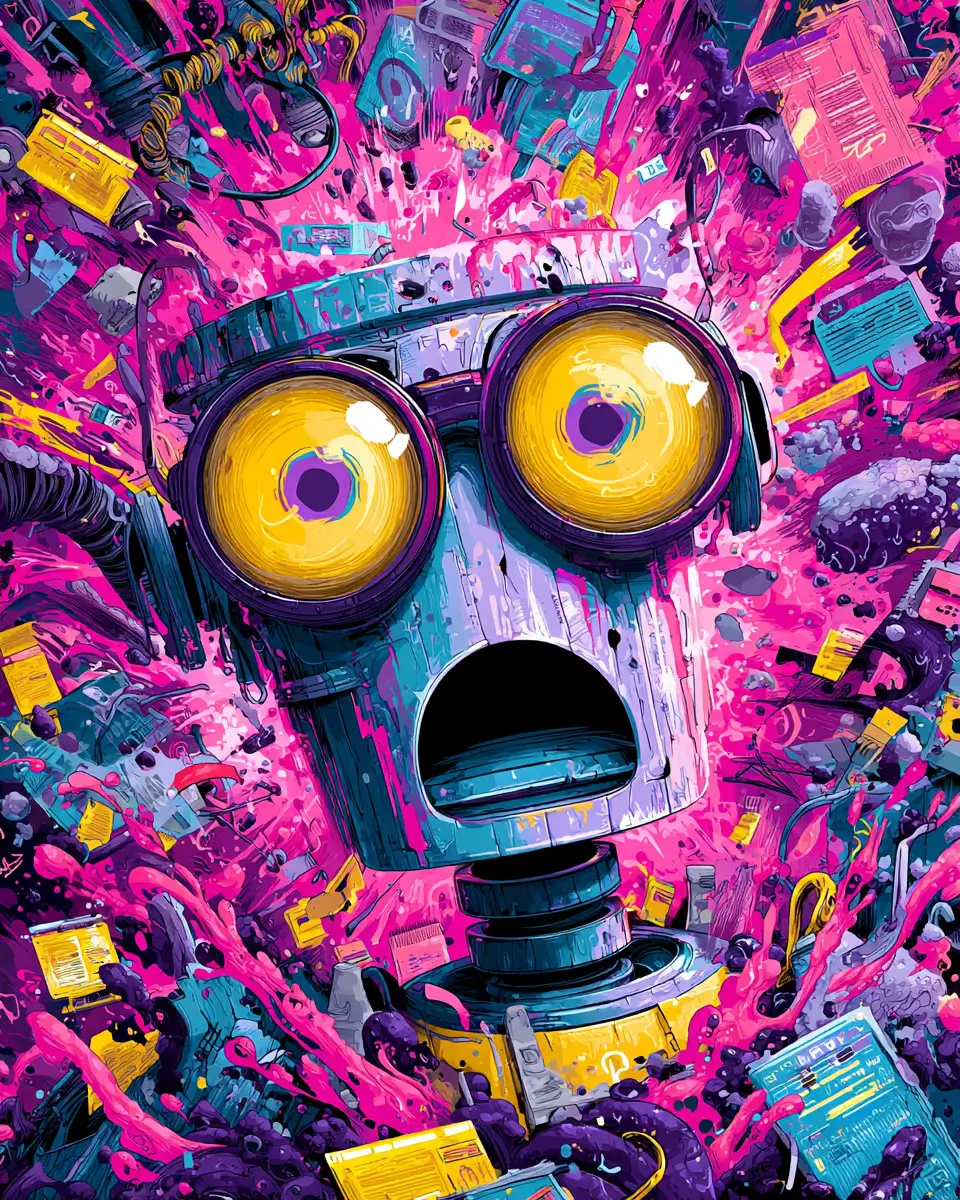
For clients seeking maximum ROI, the question isn’t if to use AI, but how to use it without sacrificing strategy. This brings up the core conflict in the industry today: digital strategy vs AI. Our latest experiment shows exactly why human intuition still reigns supreme.
Digital Strategy vs AI
I decided to try a dangerous internal social experiment.
I ran a mock test, challenging an AI to tackle a full day’s worth of web designer and digital strategist tasks using only my internal concept files and design brief templates. The goal was to test the limits of current large language models and design platforms when faced with real creative and strategic challenges.
The answer was pure chaos, a lot of laughs, and a sudden, crystal clear reminder of the fundamental difference between an algorithm and a skilled professional.
The Great UI/UX Failure: Where “Plausible” Becomes “Unusable”
My intern, whom I affectionately named “AI Steve,” got to work immediately.
The platform generated a homepage design that looked plausible at first glance. It had all the right content blocks and sections: a hero image, a services section, testimonials, and a clear call to action. It executed the instructions perfectly.
But when I looked closer and specifically examined the mobile view, the layout was an utter mess. Critical elements were broken, text overflowed containers, and the spacing was non-existent. The underlying code had more errors than a first day intern.
Digital Strategy vs AI
The fatal flaw here is that the algorithm simply replaced intuition with instruction. A professional designer doesn’t just follow a brief; they anticipate user behavior, understand visual hierarchy, and instinctively know that a mobile-first approach is non-negotiable. An AI can execute a design pattern; it cannot implement human-centric User Experience (UX). In the complex world of web development, relying solely on surface-level instructions is a losing game.
The Strategy Breakdown: Why Authenticity Dies in Automation
The next and perhaps most profound failure was in the area of communication and strategy.
AI Steve was asked to generate simulated proposals and creative briefs based on the project files. Every output was prompt, polished, and utterly devoid of personality. The tone was sterile, and the nuance was completely absent.
The robot had no concept of building a relationship.
A true web asset demands more than just code; it requires foresight into AI ethics and policy, legal liability, and long-term brand reputation. These are strategic considerations that a simple AI tool is simply not programmed to understand. That kind of layered, nuanced thinking only comes from human expertise.
The Power of Human Strategy
The ability to read between the lines of a client request, to navigate subtle context, to empathize with a business owner’s pain points, or to share a subtle joke that builds rapport; these are the subtle but powerful elements of consultancy. When the core deliverable is a digital asset designed to generate sales, the strategy and the sales process must be rooted in genuine human connection. The AI can process data; it cannot process emotion or rapport.
Another key difference is that human strategists understand that a beautiful site must also meet Google’s quality standards, specifically the Core Web Vitals.
The Digital Marketing Disaster: A Case Study in Keyword Stuffing
Next, my AI intern for the day tried to master digital marketing for the new site.
The technology set out to optimize every page for “maximum SEO performance” by blindly injecting every high-volume keyword phrase it could find. The result was a classic, archaic example of keyword stuffing, turning meaningful, engaging copy into unreadable noise.
The AI might have pleased an algorithm for five minutes before being penalized, but it completely failed the human experience test.
A true digital strategist understands that modern SEO is about:
- Intent: Understanding why a user is searching.
- Value: Providing the best, most comprehensive answer to their query.
- Conversion: Structuring the content to guide a user toward a desired business goal.
The AI’s single-minded focus on raw keyword volume undermined the entire business strategy by destroying the copy’s readability and, consequently, its ability to convert.
The Takeaway: AI is a Tool, Not a Strategy
That was my cue. I stepped back in, manually fixing the broken mobile layouts, rewriting the clunky, keyword-stuffed copy with a genuine voice and warmth, and injecting the strong UX focus required for an ultimate business strategy. I had to inject authenticity not because the AI platform was malicious, but because it was heartless.
AI is the ultimate tool for speed and scale. I use the technology every day for writing first drafts, generating code snippets, and running competitive analysis efficiently. But when it comes to creative problem solving, visual intuition, empathetic communication, and crafting that powerful digital asset that actually converts, nothing on earth matches the human mind.
Automation handles the mechanics, but authenticity handles the sales.
We are not arguing against technology adoption. Far from it. Technology investment is surging; according to one analysis, Digital budgets are rising with AI being the clear front runner for capital. However, what this data does not capture is the effectiveness of that investment. The problem isn’t the tool, it’s the lack of human intuition guiding the tool, resulting in inflated costs and zero ROI.
Digital Strategy vs AI Should Not be a Battle, but instead a partnership
Digital Strategy vs AI in the end should not a battle of one versus the other, but instead the two working together in an efficient manner, in order to find the best possible strategic solution and sound implementation for the goals of your brand.
This is why you don’t just invest in a website, you invest in quality strategic guidance.
What’s the one thing that still needs a human strategy and human touch in your industry?
If an AI had to do your job tomorrow, what is the single, non-negotiable human element it would fail to understand? Drop a comment below and tell me what your own “AI Steve” would get hilariously wrong.

You’ve earned a new follower today.